
I Built a Fantasy Baseball Database That Scores Every Qualified MLB Player And It Changes How You Should Be Drafting
1,504 hitters, starters, relievers, and prospects. Every one classified as SPARK (ascending) or FADE (declining) using real year-over-year data. The link is below

Every spring, fantasy baseball players do the same thing. They open their draft software, sort by ADP, and draft based on what the player did last year. Some of them add a gut feel modifier; this guy is due for a breakout, that guy is getting old. Most of them are wrong about both.
I spent the offseason building a different tool. It’s called the Baseball Nerd Fantasy Database, and it scores every qualified MLB player, 1,504 of them, using two frameworks I’ve been developing and validating for years.
SPARK identifies players whose underlying metrics are building toward a breakout. FADE identifies players whose underlying metrics are already showing decline, before the box score catches up.
The classification is built on real year-over-year data. Every hitter with 200+ plate appearances, every starter with 100+ innings, every reliever with 25+ innings gets evaluated. Two or more metrics moving the wrong direction and you get a FADE score. Everyone else gets a SPARK score.
The SPARK/FADE framework has been back-tested against known player outcomes. Tarik Skubal scored 81.5 (Building Toward It) in 2024, his final SPARK-eligible season. He won the AL Cy Young in 2025. Mason Miller scored 82.3 before becoming a consensus top-five closer. The model is not perfect. But it is early.
What Fantasy Players Actually Need to Know
Most fantasy baseball content answers the wrong questions. It tells you who to draft based on last year’s stats, information every other drafter already has. The edge is in forward-looking data. Here are the questions this database actually answers.
What does SPARK mean in fantasy baseball?
SPARK stands for Statistical Performance Acceleration and Rising Kinetics. A SPARK player has year-over-year metrics trending in a positive direction. A SPARK score doesn’t guarantee a breakout. It means the underlying evidence supports one before the market has priced it in.
What does FADE mean in fantasy baseball?
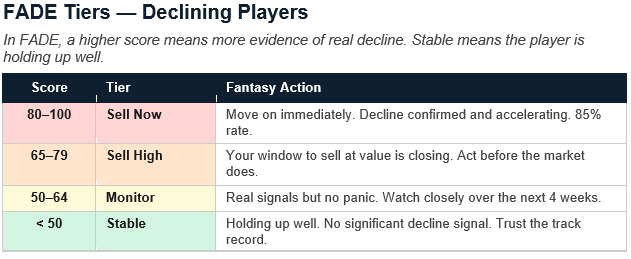
FADE stands for Force Erosion, Age Attrition, Discipline Decay, and Efficiency Collapse. A FADE player has two or more metrics moving in the wrong direction compared to the prior season. The FADE label is not a death sentence; a Monitor tier player has signals worth watching, not a reason to panic. A Sell Now player has confirmed, accelerating decline.
How do you identify fantasy baseball breakout candidates?
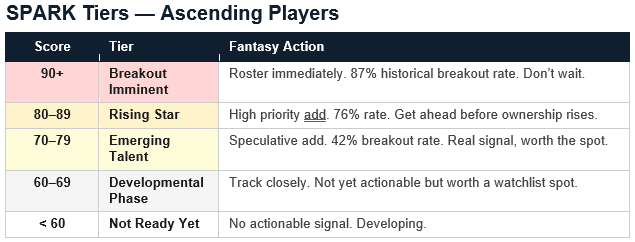
Breakout candidates share a pattern in the underlying data before they break out in the box score. The SPARK model weights this data and scores each player 0–100. Players scoring 80 or above have historically broken out at a 76% or higher rate.
How do I find players to buy low on in fantasy baseball?
Buy-low candidates show one of two patterns: their SPARK score is high but surface stats haven’t reflected it yet, or an injury-impacted season suppressed counting stats while underlying metrics stayed strong. In the Fantasy Database, filter for SPARK players in the Emerging Talent or Rising Star tier who are currently undervalued by ADP. That is the fastest path to actionable buy-low targets.
How do I find players to sell high on in fantasy baseball?
Sell-high targets are players performing well in the box score but showing cracks in the underlying data. In the database, FADE players in the Sell High tier are the ones the market is pricing on name rather than trajectory.
Understanding the Tier System
Every player gets a score and a tier. Here’s what each tier means and what to do with it in your fantasy league.
The Prospect Layer
The database includes 586 minor league prospects scored by SPARK only; there is no regression check, because ascending is the baseline for anyone still developing in the minors.
The prospect scores matter for fantasy because callup timing is everything. When a high-scoring prospect gets promoted, you want to already know their underlying numbers and not be reacting to a Twitter notification and competing against 40% of your league for the same waiver wire add.
586 prospects scored. Searchable by team, tier, position, and SPARK score. Filter to your organization’s system and see exactly who is building toward a callup and who is stalling out.
How to Use This in a Real Draft
The database is not a draft board. It is a layer of analytical context you put on top of your existing rankings. Here is how I actually use it:
• Before the draft: Filter for SPARK Rising Star and Emerging Talent players at positions of weakness. Target them 1–2 rounds before their ADP.
• During the draft: When deciding between two players at similar ADP, check their classification. A SPARK player with improving metrics beats a FADE player with a bigger name every time.
• Waiver wire: Filter for SPARK players with high scores who have low ownership. Best waiver pickups before anyone else is paying attention.
• Trade decisions: If someone is offering a FADE player at face value, you’re being sold something the model flagged weeks ago. Price it accordingly.
• Prospect watch: Sort prospects by SPARK score and filter by your league’s relevant farm systems. Set a reminder when rosters expand.
The database is live. 1,504 players. Updated for 2025.
The link and everything else in it, is below. Paid subscribers to The Baseball Nerd get full access: every player, every tier, every regression flag, the lineup builder, the compare tool, and the search filters.
The free version of this newsletter isn’t going anywhere. But this tool and the analysis that comes with it, is part of what paid subscribers get on a monthly basis.
Keep reading with a 7-day free trial
Subscribe to The Baseball Nerd to keep reading this post and get 7 days of free access to the full post archives.