
The Mound Was His
As we all take some time today to honor and remember Mom today, let's honor one who gave us a baseball treasure because she, like every mother, refused to give up on her children.

When Tim McCarver went to the mound one afternoon to talk pitching with Bob Gibson, Gibson sent him back.
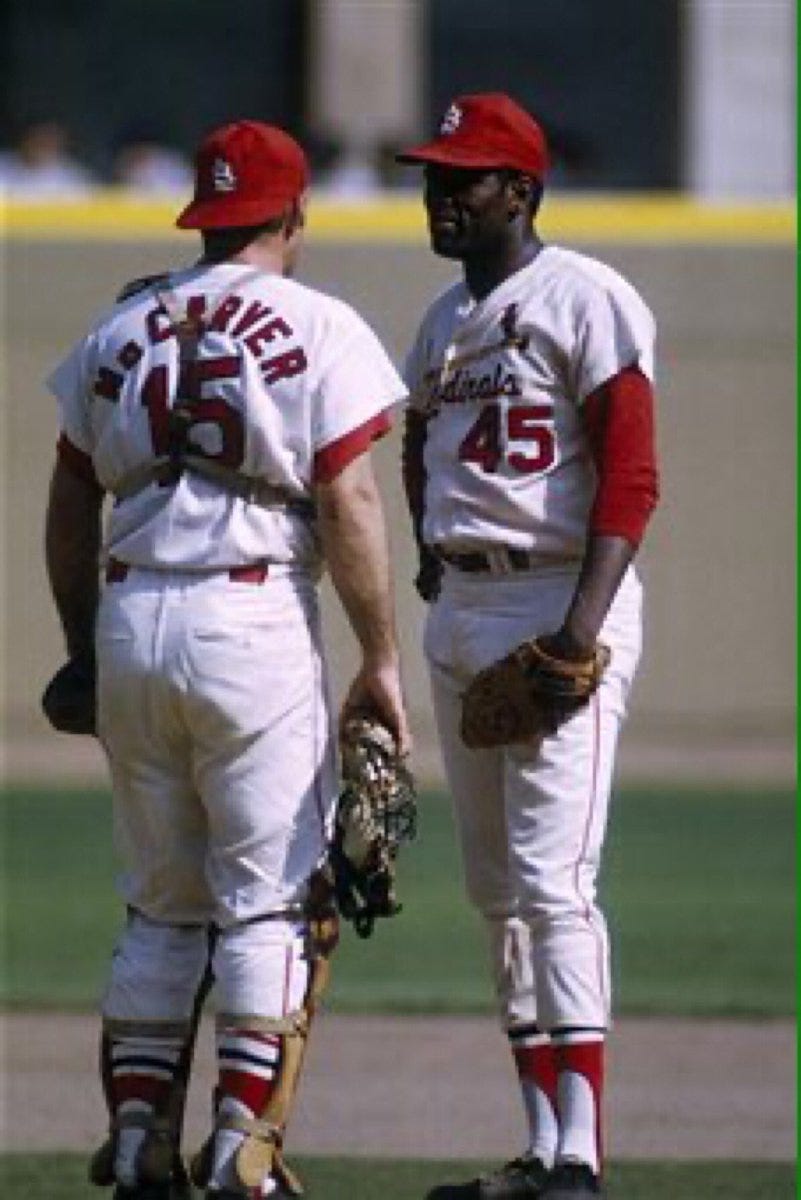
“The only thing you know about pitching,” Gibson told his own catcher, “is that it’s hard to hit.”
That was Gibson in one sentence. The plate was his. The mound was his. The conversation was over when he decided it was over. He did not share authority on a pitcher’s mound with anyone, including the man wearing his own team’s uniform.
People called it meanness. Gibson called it something else.
The Housing Project on Omaha’s North Side
Pack Robert Gibson was born November 9, 1935, the youngest of seven children. His father, also named Pack, died of tuberculosis before Bob was born. That left Victoria Gibson alone with seven kids, no income, and a four-room shack with no heat and no electricity on Omaha’s north side.
She worked in a laundry. She cleaned houses. She kept the family together long enough for them to move into the Logan-Fontenelle housing projects, which was an upgrade. She raised seven children without a husband, without money, and without any particular reason to believe the youngest one would end up with a bronze statue outside a major league ballpark. She did it anyway.
He survived pneumonia as a child. He had a heart murmur. He developed rickets, a bone disease that would contribute to arthritis in his pitching elbow later in his career. His brother Josh, sixteen years older, essentially raised him and organized youth sports teams at the local recreation center to keep neighborhood kids off the streets.
Gibson was good at everything. Basketball was his best sport, and he was an all-city selection at Omaha Technical High School. When he tried out for the baseball team his junior year, a coach turned him away. He found out years later it was because the coach didn’t allow Black players on the team. He ran track instead, set an Omaha indoor record in the high jump, and waited.
Indiana University rejected his scholarship application with a letter explaining they had already filled their “quota of Negroes.” He enrolled at Creighton University instead, becoming the first Black athlete to receive a basketball scholarship there. He averaged 20.2 points per game and set a school career scoring record. His jersey number was later retired.
By the time a Cardinals scout offered him a $4,000 bonus to play baseball, Gibson had already spent years being told what he couldn’t do and by whom. He signed. He also spent a year playing basketball with the Harlem Globetrotters first, because the competition in baseball’s minor leagues didn’t feel sufficiently intense by comparison.
He Kept Calling Him Bridges
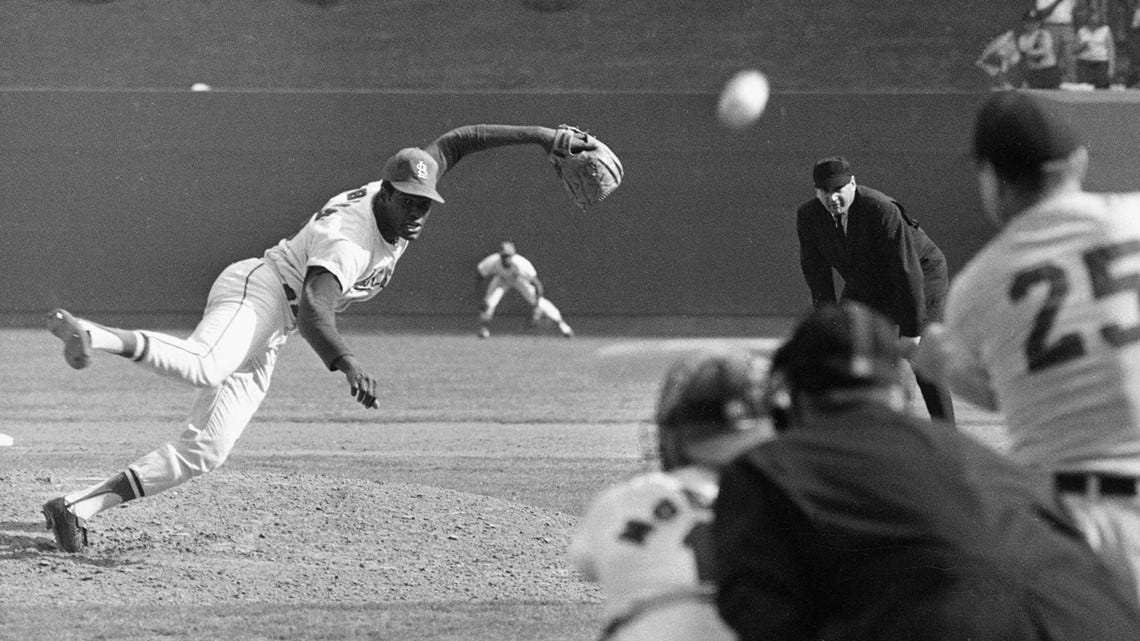
The Cardinals’ early manager Solly Hemus berated Gibson after every mistake, told him he would never make it in the majors, and regularly confused him with another Black pitcher on the roster named Marshall Bridges. Bridges was several years older, skinnier, and threw left-handed. Hemus kept calling Gibson “Bridges” anyway. He got the color right.
When Johnny Keane replaced Hemus in July 1961, Gibson went 11-6 the rest of the season. The difference was not Gibson’s ability. The Cardinals went 47-33 under Keane after going 33-41 under Hemus.
From that point, Gibson constructed one of the most deliberately intimidating presences the game had ever seen. His cap pulled low. His eyes fixed on the batter. His delivery so violent toward the first base line that hitters felt he was exploding off the mound at them. He did not fraternize with opposing players. At the 1965 All-Star Game, Joe Torre caught Gibson in the ninth inning and afterward complimented his pitching in the locker room. Gibson got dressed and left without responding.
The inside corner of the plate was non-negotiable. “I believed that the inside part of the plate belonged to me,” he said. Batters who crowded the plate could expect a fastball up and in. He described his full arsenal in his 1992 autobiography: “I actually used about nine pitches: two different fastballs, two sliders, a curve, a change-up, knockdown, brushback, and hit-batsman.” He listed hit-batsman as a pitch.
The Myth He Built and Then Denied
Here is what the records actually show about Bob Gibson’s ferocity.
In 3,884 career innings, he hit 102 batters. One every 38 innings. Don Drysdale, widely regarded as another headhunter of the era, hit a batter every 22 innings. Pedro Martinez hit one every 20. By the numbers, Gibson was not an executioner. He never led the league in hit batsmen. He finished in the top six seven times, but he also finished in the top four in innings pitched seven times. He was throwing a lot of pitches at a lot of batters. The ratio was ordinary.
Gibson himself pushed back on the mythology throughout his career. “Hitters don’t get intimidated,” he told a reporter late in his life. “That was just one of those things people said.” He had a sharper line about the brushback reputation: “If I threw at a batter, I hit him.”
Even the famous glare turned out to be something else. He was nearsighted and refused to wear glasses on the mound. He couldn’t clearly see the catcher’s signs. The scowl was concentration, not menace. He once told Willie Mays the story. Mays, who hit .196 against Gibson for his career, admitted afterward that he had always been a little leery of the inside pitch. Whether that was intimidation or simply respect for a great pitcher is difficult to say.
What Gibson built was a myth so thoroughly believed that it worked regardless of whether it was true. Bill White, his Cardinals teammate and closest friend on the club, was asked once what made Gibson such a fierce competitor. White needed only three words: “He went through hell.”
The Season That Changed the Rules
In 1968, Bob Gibson did something that led Major League Baseball to change the rules of the game.
He went 22-9 with a 1.12 ERA, the lowest of any qualifying pitcher since 1914. Batters hit .184 against him. He threw 28 complete games and 13 shutouts in 304 innings. He had a streak of 47 consecutive scoreless innings. He won the National League MVP and the Cy Young Award unanimously.
After that season, MLB lowered the pitcher’s mound from 15 inches to 10 and narrowed the strike zone. The changes were aimed at restoring offense to a game Gibson had essentially taken apart. Some called it the Gibson Rule. He had pitched so well that baseball rewrote itself to try to stop him.
In the 1968 World Series against Detroit, he struck out 17 batters in Game 1. It remains the World Series single-game strikeout record. He also broke his own record of seven consecutive complete-game World Series victories in Game 4, giving the Cardinals a 3-1 series lead. The Tigers came back to win in seven. In Game 7, Gibson gave up three runs. The other team scored four, including three on a misplayed fly ball by Curt Flood in the seventh. He had done everything he could.
Seven Wins, Two Championships
Across three World Series appearances in 1964, 1967, and 1968, Gibson went 7-2 with a 1.89 ERA. He completed eight of his nine starts. He struck out 92 batters in 81 innings. He was named Series MVP in 1964 and again in 1967. Both years, the Cardinals won.
In 1967, a Roberto Clemente line drive struck Gibson in the right shin during a July game against the Pirates. The leg was cracked. Gibson pitched to three more batters before it finally snapped. He was back in September, finished 13-7 for the year, and won all three of his World Series starts against the Red Sox as complete games.
He was a nine-time All-Star, a two-time Cy Young winner, a two-time World Series MVP, and a nine-time Gold Glove winner from 1965 through 1973. He finished his career with 251 wins, 3,117 strikeouts, a 2.91 ERA, and 81.7 career WAR across 17 seasons, all with St. Louis. He was elected to the Hall of Fame in 1981, his first year of eligibility. He was just the second Black pitcher inducted, after Satchel Paige.
Gibson died of pancreatic cancer on October 2, 2020, at 84 years old. He went home to Omaha, to the city that had turned him away from a baseball team and rejected his scholarship applications and handed him a career’s worth of reasons to be angry.
He used every one of them. He listed knockdown, brushback, and hit-batsman as pitches, and whether he threw them or not, every batter who ever stepped in against him believed he would. That belief was the whole thing. You don’t build a myth like that with a fastball. You build it with seventeen years of refusing to give an inch to anyone.
The mound was his. He made sure of it from the first pitch to the last.
Sunday Stories · Timeless baseball stories, delivered weekly
Outstanding article! Thank you! He was great, plain and simple, after overcoming incredible hardships…his mother is a saint and a true hero!
Great article!
Bob Gibson's overall career was unbelievable. He did everything he could to help his team win. He often suffered from lack of run support, so he had to pitch through many high-stress innings. He usually pitched on short rest in September and during the World Series. In addition to the Gold Gloves, he hit 24 home runs, drove in 144, and even stole some bases.