
The Phone That Never Rang
A Sunday Story about the winter baseball's owners secretly agreed to steal free agency back, and the World Series MVP they couldn't keep down.

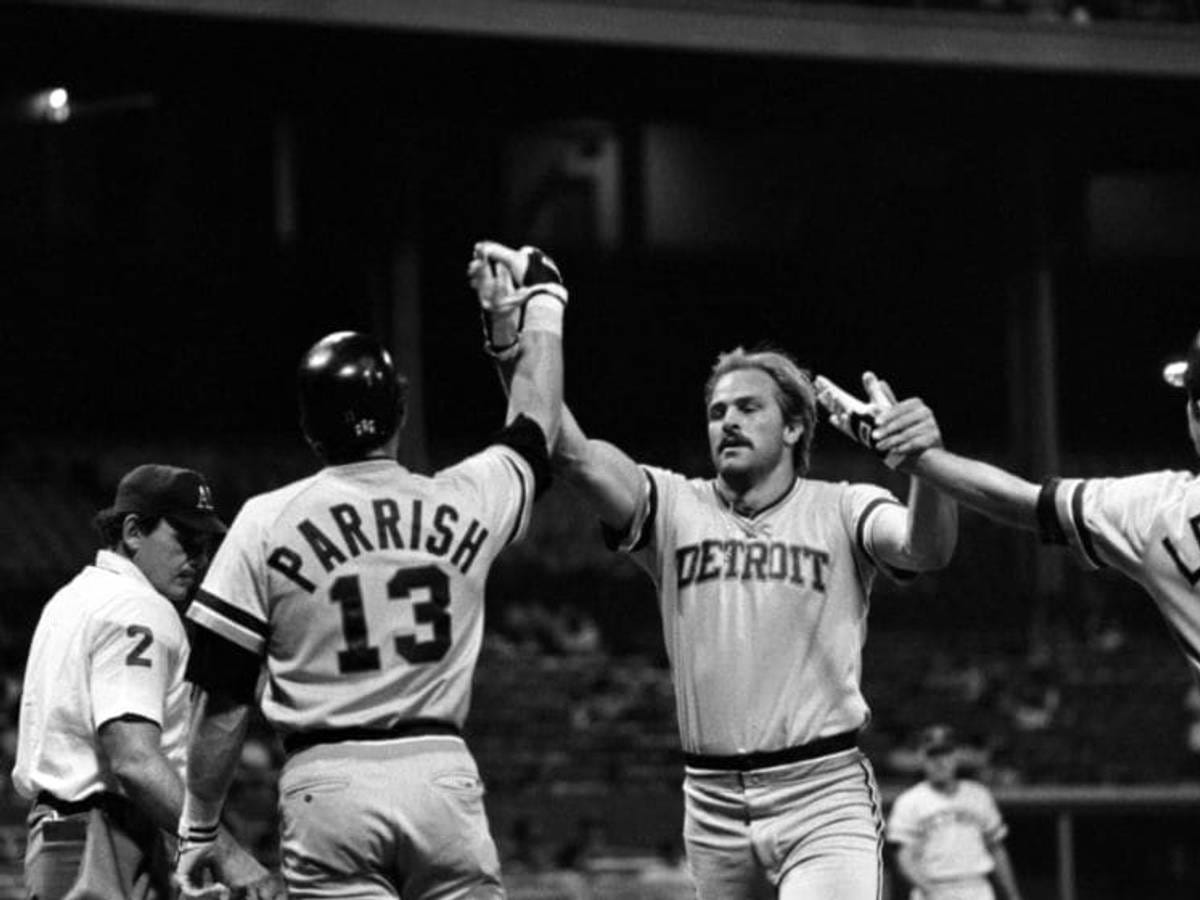
Kirk Gibson went bird hunting with people from the Kansas City Royals in the winter of 1985. He had just hit 29 home runs and driven in 97 runs for the Detroit Tigers. He was the best position player on the free agent market. He figured the hunting trip was the start of something.
While he was tromping through the woods, his agent called the Royals’ general manager. The answer stunned him. “Yes, Kirk Gibson is a fine ballplayer,” John Schuerholz said, “but I really don’t think we have any interest.”
The agent called every other team. He got the same answer from all of them.
Gibson re-signed with Detroit for $1.2 million a year, less than he had asked for, because there was nowhere else to go. The market had vanished overnight. It would take three years of arbitration hearings, 618 exhibits, and 14,028 pages of testimony to prove what everyone in baseball already suspected: the owners had secretly agreed not to compete for each other’s free agents. They had stolen back the system Messersmith and McNally had broken open ten years earlier.
They called it Collusion. Baseball called it three separate cases. The players called it theft.
Peter Ueberroth’s Bright Idea
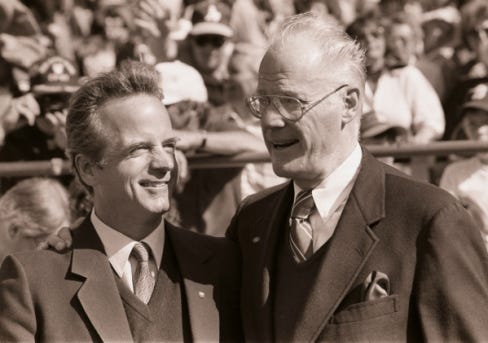
Peter Ueberroth had just finished running the 1984 Los Angeles Olympics, widely considered the most successful Games in decades. He arrived as baseball commissioner in October 1984 with a businessman’s eye for the game’s finances, and what he saw worried him. Owners were spending recklessly on free agents, running deficits, and blaming each other for the escalating payrolls.
On October 22, 1985, Ueberroth met with the owners in St. Louis. His message was direct: the clubs were spending themselves into ruin. He told them: “If I sat each one of you down in front of a red button and a black button and I said, ‘Push the red button, and you’d win the World Series but lose $10 million; push the black button, and you would have a $4 million profit,’ you are so damned dumb, most of you would push the red button.” He closed with: “I know and you know what’s wrong. You are smart businessmen. You all agree we have a problem. Go solve it.” Some owners stood up to confess their past stupidity. Some took the pledge to abstain from free agents. Baseball’s collusion era began the following day.
The first sign came the very next day. Tigers GM Bill Lajoie was negotiating a long-term deal with Lance Parrish’s agent, Tom Reich, and the talks had been going well. Then Lajoie’s position changed overnight. “I don’t know quite how to tell you this,” Lajoie said, “but we have reviewed this and decided that the best we can offer is a two-year contract and not at the kind of money we have been talking about.” Reich asked where that came from. Lajoie said only: “We had some meetings and decided that these are the economics.” Reich called Parrish immediately. “Something’s up,” he said. He was right.
Within weeks, the winter free agent market went silent. In the offseason before 1985, 20 of 46 free agents had signed with new teams. In the offseason after Ueberroth’s meeting, of 35 free agents only four changed teams, and those four were players their original clubs had already given up on. What became known as Collusion I had begun.
Each winter, the scheme escalated. In Collusion II, the average free agent salary actually declined by 16 percent while MLB revenues rose 15 percent. That inversion, players getting poorer as the game got richer, told the whole story. By Collusion III, the owners had formalized their system into what they called an Information Bank, an actual database that logged every contract offer in the market so no team would accidentally outbid another. It was organized, documented, and in direct violation of Article XVIII of the Collective Bargaining Agreement, which explicitly prohibited clubs from acting in concert to restrict player movement.
Commissioner Fay Vincent would later tell the owners plainly: “You stole $280 million from the players, and the players are unified to a man around that issue, because you got caught and many of you are still involved.”
The Players Nobody Would Sign
Kirk Gibson was the most visible casualty of Collusion I, but he was not alone. Carlton Fisk, a future Hall of Famer, sat unsigned. Tim Raines, one of the best leadoff hitters in baseball, was forced to re-sign with Montreal because no other team would touch him. Jack Morris, a 20-game winner, offered to sign a one-year deal at whatever salary an arbitrator set with the Yankees, Angels, Twins, or Phillies. All four turned him down.
Andre Dawson, a star outfielder who desperately wanted to leave Montreal’s artificial turf for his aching knees, walked into the Cubs’ offices in spring training of 1987 and handed them a blank contract. He told them to fill in whatever number they thought was fair. The Cubs wrote in $500,000, less than half what he had made the previous year. Dawson signed it on the spot. He had no other options.
Dawson went on to hit 49 home runs and win the NL MVP that season, one of the most lopsided bargains in baseball history. The Cubs had handed him a half-price contract and he had handed them back an MVP-caliber offensive season for less.
The players union, now led by Donald Fehr after Marvin Miller’s retirement, filed its first grievance in February 1986. Arbitrator Thomas Roberts heard the case through 1987. On September 21, 1987, he ruled that the owners had violated the CBA. It was the first of three decisions that would go the same way.
Gibson Goes Bird Hunting Again
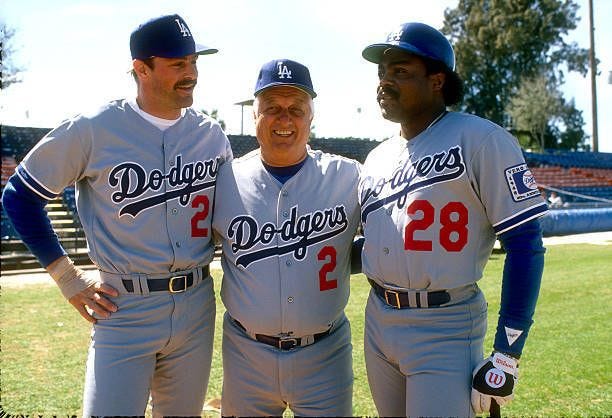
On January 22, 1988, arbitrator Roberts declared seven players “new look” free agents, giving them a window to sign with any team despite already being under contract. The seven were Juan Beniquez, Tom Brookens, Kirk Gibson, Carlton Fisk, Donnie Moore, Joe Niekro, and Butch Wynegar.
Gibson had ten days. The Dodgers called immediately.
Los Angeles general manager Fred Claire had been trying to acquire Gibson for months. The Dodgers had finished 73-89 the year before, seventeen games behind the Giants. They needed a leader. Gibson, who had been stewing in Detroit for three years watching his free agency stolen from him, needed somewhere to direct his anger.
He signed a three-year, $4.5 million contract on January 29, 1988. Ten days later he was in Dodger camp, and on the first day of spring training a pitcher named Jesse Orosco put shoe polish in his cap. Gibson stormed off the field and nearly quit. Dodgers manager Tommy Lasorda talked him back. The episode established exactly who Gibson was going to be in Los Angeles: a man who took everything personally and played like it.
“I was with the Tigers my whole career and went through collusion and I had to stay there,” Gibson said years later. “When I left Detroit, a lot was said about me. They attacked me and my character and said things about my family. I told my parents, ‘Don’t worry about it. We’ll have our day.’”
The Limp, the Pump, the Fist
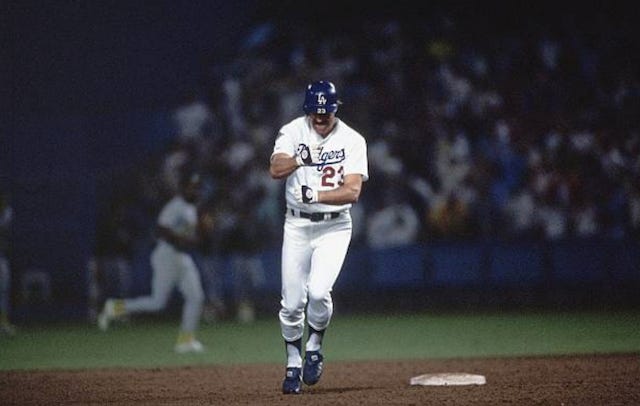
Gibson won the NL MVP in 1988. He hit .290 with 25 home runs and 31 stolen bases and dragged a Dodgers team with almost no business being there to the World Series against the heavily favored Oakland Athletics.
He wasn’t supposed to play in the Series. He had torn ligaments in his left knee and strained his right hamstring in the NLCS against the Mets. He could barely walk. Vin Scully told the national television audience before Game 1 that Gibson would not be available.
Gibson was in the training room watching on a television when he heard Scully say it. He threw the ice off his legs, told the bat boy to set up a tee, and went to work in the tunnel under Dodger Stadium, taking practice swings alone in the dark.
The Dodgers were losing 4-3 in the bottom of the ninth with two outs when Lasorda sent Gibson up to pinch hit against Dennis Eckersley, the best closer in baseball. Eckersley had a 0.87 WHIP that season. He had allowed only three baserunners in six innings in the ALCS.
Gibson worked the count to 3-2. Eckersley threw a backdoor slider. Gibson turned on it and hit it into the right field bleachers. He pumped his fist rounding first base. He pumped it again. The limp was real but the fist was realer.
Vin Scully said nothing for over a minute. He let the crowd tell the story.
It was Gibson’s only at-bat of the 1988 World Series. The Dodgers won in five games.
What $280 Million Proved
The three collusion cases, decided in 1987, 1988, and 1990, generated 71 days of hearings and established beyond any reasonable doubt that the owners had conspired to eliminate the free agent market for three consecutive winters. On October 26, 1990, they agreed to pay $280 million in damages, roughly $10.77 million per team.
No owner was suspended. No executive was fired. Ueberroth, whose meeting had started it all, had already left the commissioner’s office in 1989. The owners wrote a check and went back to business.
What the collusion era proved, however, was something the owners had been trying to obscure since Messersmith and McNally: the free agent market worked exactly as the players said it would. When owners competed honestly for players, salaries rose to reflect actual value. When they stopped competing, salaries fell immediately. The market was real. The owners’ claim that free agency would destroy baseball was false. What they actually feared was paying players what they were worth.

Gibson’s career arc tells the whole story in shorthand. Collusion kept him in Detroit for three years at below-market rates. When a arbitrator freed him, he went to Los Angeles and won an MVP and a World Series in the same season. The owners paid $280 million for the privilege of having suppressed him.
The collusion era did not end cleanly with the $280 million settlement. The poison it introduced into the relationship between owners and players lingered for years. The 1994 strike, which cancelled the World Series for the first time since 1904, grew directly from the accumulated bitterness of players who had watched ownership steal three winters of their earning power and then write a check to make it go away. The owners had not changed. They had just changed their methods.
With the 2027 CBA approaching, the owners are making versions of the same arguments they made in 1985. Service time manipulation, draft slotting, pre-arbitration salaries, the luxury tax threshold. The mechanisms are different. The goal is the same: pay players less than the market says they are worth, and make it look like policy.

The players have been down this road before. They know where it leads. So does the arbitration record.
Sunday Stories · Timeless baseball stories, delivered weekly
Fascinating article - thank you for posting this.
Marvin Miller remarked that the owners "conspired to fix the pennant race". Yet from 1985 to 1987, there were 11 (out of 12) different division winners. Did the lack of free agency have any effect on this competitive balance? 🤔
Good stuff. You threw me with the Cy Young reference!