
There is a Difference Between Decline and Transition
Is the Houston dynasty over?

Third in my AL West series, five teams, five weeks, one division, using FanGraphs underlying metrics and payroll data to get past the narrative and look at what each roster is actually built to do. Houston is the hardest piece to write because the dynasty is real, the decline is real, and both things are true at the same time. Yordan Alvarez needs to have one of the best offensive seasons in baseball while the infrastructure around him quietly ages out.
What the Numbers Actually Say
Start with the foundation. Yordan Alvarez is 29 years old, paid $19.2 million per year, and produced a 156.1 wRC+ over the last three seasons with an xwOBA of .420. He underperformed his expected output. He is the best hitter in the division and he is not yet in decline. That is the Astros’ most important fact.
Spring has not clarified much about Yordan yet. Eight games, 23 plate appearances, a .273/.304/.500 line against 7.1 OppQual competition. Solid, functional, not explosive. At 29 and coming off a healthy season, the absence of red flags is the signal.
The second most important fact is the one nobody wants to say out loud in Houston. Jose Altuve’s 128.1 wRC+ carries the largest positive luck gap on the roster. He is 36. His true talent level, based on contact quality, is closer to a 100-105 wRC+ hitter. That is still above average, but it is not the player the current contract is paying for. The regression is coming. The only question is whether it arrives this year or next.
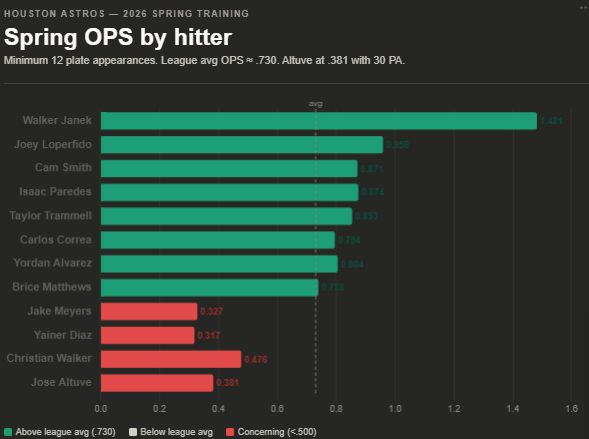
Spring is not helping Altuve’s case. Ten games, 30 plate appearances, a .107/.167/.214 slash line. That is a .381 OPS against decent competition. Sample sizes are small and spring lines are easy to dismiss. But Altuve was listed at age 36 in this data, not 35. The production gap between his expected and actual output is widening, and this spring has not provided any counter-evidence.
Carlos Correa adds defensive value and posted a .278/.350/.444 line in limited spring action. Isaac Paredes has been quietly productive, hitting two home runs with a .874 OPS in 23 plate appearances. Christian Walker, however, is a concern. Three hits in 29 plate appearances, a .476 OPS. The $20M veteran has not found his bat yet.
39.4% of the Houston luxury tax payroll is committed to players 32 or older. That number is not a death sentence, but it is context for everything that follows.
The Kyle Tucker Problem
Tucker was traded in 2025. He was their best outfielder and one of the better bats in the AL. His departure created a hole in right field that the current roster has not filled on paper.
Jake Meyers in center field produced 92.4 wRC+ over three seasons, below league average, and his spring confirms it. A .125/.160/.167 line in 25 plate appearances is the kind of number that would be alarming if his bar were higher. It is not alarming so much as expected.
Joey Loperfido is the early spring positive story in this outfield. Thirty-eight plate appearances, .355/.474/.484, seven walks against six strikeouts, facing a 7.3 OppQual average. The walk rate is the real number. For a player who the Astros acquired quietly, this is the kind of evidence-based case that earns a roster spot.
Cam Smith is the bet. He has hit .267/.371/.500 in 35 spring plate appearances against 6.9 competition. For a 23-year-old with one spring already behind him, those underlying ratios still read as legitimate. He takes walks. He hits for power. The framework says trust it. But Smith is being asked to replace Tucker’s production in year one at the major league level, and that remains a significant ask regardless of what the data shows in March.
Taylor Trammell, the new signing in left, has quietly put together one of the better offensive springs on the roster. A .250/.385/.469 line with seven walks in 39 plate appearances against 7.1 competition is not flashy but it is functional. His presence matters more as depth than as a star.
The Pitching Question
The rotation is where this team’s ceiling is determined, and three things need to be said clearly before getting to the good news.
First, the injury list. Ronel Blanco had Tommy John surgery in June 2025 and is out. Hayden Wesneski had Tommy John in May 2025 and is out. Brandon Walter had Tommy John in September 2025 and is out. Three rotation arms gone before Opening Day. That is not a small footnote.
Second, Josh Hader is on the IL with biceps inflammation since February. The closer is unavailable to start the year. Houston’s ninth inning is unsettled.
Now the good news.
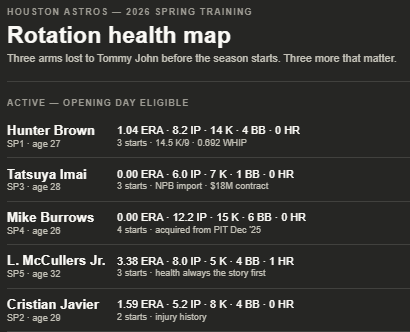
Hunter Brown is the anchor and he looks like it. Spring stats: 1.04 ERA in 8.2 innings across three starts, 14 strikeouts, four walks, zero home runs. That is a 14.5 K/9 with a 0.692 WHIP. For a 27-year-old in arbitration year one, this is the kind of spring that validates his ceiling. He is the legitimate top-of-rotation arm Houston has been building toward.
Tatsuya Imai, the $18M NPB import, is the biggest question mark on the roster, and his spring has been encouraging. Three starts, 6 innings, 0.00 ERA, seven strikeouts, one walk, 0.500 WHIP. The competition level matters here, his OppQual score is not yet established, but you cannot walk one batter in six spring innings by accident. File this in the cautious optimism column, not the confirmed arrival column.
Mike Burrows came over from Pittsburgh in December and has the best spring ERA on the staff. Four starts, 12.2 innings, 0.00 ERA, 15 strikeouts, six walks. Zero home runs allowed. He is projected as the fourth starter and pitching like he wants the third spot.
Lance McCullers has thrown three clean starts, eight innings, 3.38 ERA. For McCullers, the health is always the story first. Being upright and functional in March is itself meaningful context.
Ryan Weiss, the KBO signing, has thrown 9.2 innings with a 0.93 ERA and a reasonable K/BB profile. He is quiet competition depth that could matter if the injury attrition continues.
Spencer Arrighetti, projected as the sixth starter, has the numbers you would expect from a boom-or-bust arm. A 6.75 ERA in eight innings, 12 strikeouts, but two home runs and five walks. He is who he has always been.
The Bullpen Situation
This is where the article finds its most interesting story.
Bryan Abreu is the projected closer with Hader out and his spring has been exactly what you would hope. That is the established piece. What nobody is talking about are the two arms Houston assembled out of the discard pile.
Last December, Houston signed Christian Roa off the Marlins roster and grabbed Roddery Muñoz in the Rule 5 draft out of Cincinnati. Neither had a single headline attached to the move.
Roa has thrown 8.2 innings across eight appearances without issuing a single walk. One earned run. A 0.577 WHIP. Zero free passes in 8.2 innings is a real number you cannot manufacture. Muñoz matches him on swing-and-miss: eight outings, 8.1 innings, 14 strikeouts against one walk, a 14.00 K/BB ratio. Combined, these two have thrown 17 innings, struck out 26, walked one, and allowed three earned runs. A 26:1 K/BB ratio. Neither faced elite competition, OppQual scores of 6.7 and 7.0 respectively, but the command is real.
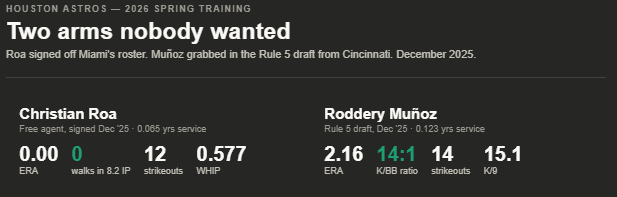
With Hader’s timeline uncertain, AJ Blubaugh (1.17 ERA, 7.2 IP) and Christian Roa give this bullpen more functional depth than most casual observers will expect.
Do the Astros Win the AL West in 2026?
The honest answer: probably not the division title, but absolutely a playoff contender.
Yordan Alvarez at full health is the best offensive player in the AL West. The core, Paredes, Correa, Loperfido, Trammell, and a healthy Diaz, produces above-average offense at multiple positions when firing. Brown is a legitimate ace. The bullpen is deeper than the Hader absence suggests.
The risks are real. Altuve’s spring has been poor and his luck-adjusted decline is not a narrative, it is the data. Walker has not hit. Smith in right field is still an unknown. The rotation lost three arms to Tommy John before the season started. And Imai is an $18M question mark backed by a 0.00 spring ERA that requires significant context before drawing conclusions.
The case against contention requires several things to go wrong simultaneously. The case for contention requires Yordan to stay healthy, Loperfido and Smith to be who the spring data says they are, and Brown to pitch like an ace through six months.
The Astros are not in decline. They are in transition. The dynasty window has likely closed. What is opening in its place is a different kind of contender, one built around a franchise anchor in his prime, a young supporting cast still being assembled, and a financial structure that creates real flexibility within two years.
That is not a rebuilding story. It is a reloading story. Whether the AL West allows it is the question we will be answering all season.
Living in Astros country, I’ll take that for my friends’ sakes and hope on the offense. The Mariners are pretty stacked, but no other team really shows the talent to separate. Transitions require transfusions, and I don’t know if the minor league system can offer a difference maker because most pundits have them ranked pretty low.